





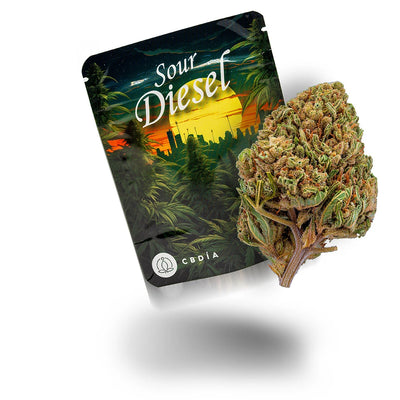

By Jona Decker: Anyone wanting to gauge THC or CBD levels in flower quickly comes across rapid tests, test kits and the odd THC meter. Such solutions seem practical mainly because they promise results on the spot. In practice, however, how meaningful the result is depends heavily on the sample, the method, calibration and how it is used. Measuring THC content or measuring CBD content therefore doesn't automatically mean getting a legally or technically reliable value.
For a reliable assessment, lab certificates issued per batch are considerably more informative, because they use standardised procedures and documented test conditions. This article explains the limits of devices and tests in a factual way. CBDÍA addresses adults aged 18 and over exclusively and makes no consumption, dosage or health claims.
THC Meter: What It Can Really Measure
Depending on the method used, a THC meter, a THC tester or a THC test kit can give an indication of whether cannabinoids are detectable in a flower sample and roughly what order of magnitude the THC content might be. That can be useful for a quick orientation, for example to roughly gauge differences between samples. However, anyone wanting to measure THC content and draw legal or qualitative conclusions from it should know the limits of such methods.
To see what a professional analysis report looks like, visit CBDÍA Lab Certificates; the THC Elimination Calculator estimates how long it can be detected in the body.
Many rapid tests work with colour reactions or simplified measuring principles. They can produce results that are influenced by sampling, moisture, storage, handling and calibration. A meter also often only measures a small section of the sample; flower, however, is not homogeneous. That's why a single value is rarely accurate enough to reliably judge whether a CBD product is fit to be placed on the market.
Analyses are reliable above all when a representative sample is examined in a laboratory, ideally per batch and with a traceable method. Rapid tests do not replace such a lab certificate. They can support a preliminary check, but without context they say little about whether a product reliably stays within the applicable limits.
How Can I Measure THC Content?
Anyone wanting to measure THC content should distinguish between methods by how informative they are: a rapid test usually only gives a rough indication, a portable meter can estimate values within a certain measuring range, and a laboratory analysis determines the content far more reliably. The sample, method and material are always decisive, because cannabis is a natural product and not a completely homogeneous substance.
Sample and Material: Why Flower Varies
Testing flower with a rapid THC test doesn't automatically mean the result reflects the whole batch. Individual flowers, leaf portions or resinous areas can differ in composition. That's why how informative the result is depends heavily on whether the sample is representative and how evenly the material was prepared. Even small differences can already cause measured values to vary, even though it's the same cannabis.
Cannabis Is Not Uniformly Composed Throughout
Cannabinoids can be distributed unevenly even within a single plant. A cannabinoid meter can make such differences visible, but it doesn't automatically replace a validated laboratory test. What matters is whether the device is suited to the particular matrix and which range it can reliably capture. This makes it possible to put results into perspective better, without overrating them as final proof.
How Accurate Are THC Testers for Home Use?
A THC tester for home use can help to roughly classify a CBD flower, but it doesn't provide as reliable a statement as a laboratory analysis. How accurate a result is depends, depending on the method, on sample quality, material moisture, homogeneity, interfering factors and the user's interpretation. Deviations are especially possible with a rapid THC test for flower, because THC and other cannabinoids are not evenly distributed in plant material.
Colour Tests: A Quick Estimate, Not an Analysis
Colour tests are usually based on a chemical reaction in which a solution changes colour. A THC test kit can thereby give an indication of whether certain cannabinoids are present or roughly which range a rough estimate falls into. The result, however, remains qualitative or semi-quantitative: similar shades of colour, accompanying substances and subjective perception can influence the outcome. Such tests are therefore more suitable for orientation, not for determining an exact THC content or replacing a lab certificate.
Portable Devices: Dependent on Calibration
Depending on the device, a cannabinoid meter uses different measuring principles, such as spectroscopic methods and stored reference data. Portable systems seem practical, but their accuracy depends heavily on calibration, the underlying data, sample preparation and material quality. Mobile solutions, too, can be sensitive to moisture, contamination or unevenly ground flower. A portable THC tester can therefore show trends, but cannot replace a guaranteed precise laboratory result. What matters is that measured values are correctly interpreted and not understood as absolute truth.
Measuring CBD Content: What's Different?
Anyone wanting to measure CBD content usually doesn't look at just a single value. For classifying flower, what matters above all is how high the CBD proportion is and whether the THC content stays below the relevant limit. With CBD flower, the legal focus is often on proving that the THC value per batch does not exceed 0.3%. That's why a batch-specific lab certificate is more informative than a general reference to strains or to the plant.
Looking at THC and CBD Together
A laboratory profile can report several cannabinoids at the same time, showing THC and CBD in relation to each other. Anyone having CBD content measured ideally receives not just isolated values but an overall analytical picture of the sample. This helps to classify the active compound content factually, without deriving statements about effects from it. While rapid tests can give an initial orientation, they do not replace a full batch-specific test when reliable figures are needed.
Measuring THC content therefore differs less in technical terms than in the relevance of the assessment: for CBD products, the THC proportion determines whether the requirements are met. Other measured values can be of additional interest, but the central legal classification rests on the verifiable THC limit.
Precise in the Lab, Not Just Approximate
Rapid tests and simple devices can provide an initial orientation but do not replace a laboratory analysis. Anyone wanting to classify THC content legally and qualitatively, or to understand the CBD proportion, needs results that match the specific product and are cleanly documented.
Checking the Lab Certificate per Batch
What matters is that the certificate was issued per batch. Only then can it be established whether the analysis genuinely matches the flower on hand. No blanket conclusions should be drawn from an older certificate or from details of other batches, even if the product name or strain sounds similar. A laboratory analysis is precise because it examines a defined sample. Anyone wanting to measure THC content and assess it reliably should therefore always check the batch number against the packaging or product documentation.
What Should Be on the Certificate
A useful certificate states the product name, the batch number, the testing laboratory, the date and the cannabinoid values reported. Depending on the analysis, this also includes THC, THCA, CBD and further values. It's also important that the THC value is below 0.3%. Provenance details with country, cultivation type and a reference to hemp from the EU catalogue of plant varieties are useful. Anyone wanting to measure or compare CBD content should check whether the lab tests regularly and whether the figures are traceable per batch. This makes it possible to read results reliably, without reading more into them than the laboratory analysis actually shows.
What to Look for When Buying CBD Flower
Anyone wanting to buy CBD flower should rely less on their own rapid test result than on traceable quality evidence. Simple kits can give rough indications, but they usually cannot measure CBD or THC content as precisely as a laboratory. It therefore makes sense, when buying, to look for a current lab certificate, the country of origin, the cultivation type and clear information on sale only to adults aged 18 and over. An advantage of transparent providers is that they make documents available that offer orientation and provide relevant values per batch.
CBDÍA: Batch-Tested and 18+
CBDÍA positions itself through batch-tested CBD products and puts quality and compliance aspects front and centre. Anyone wanting to measure CBD content finds, depending on the product, a more reliable basis in laboratory analyses than in home tests. The tested batches are documented regularly; products are sold exclusively to adults aged 18 and over.
Conclusion: Put the THC Meter in Perspective, Check the Certificate
A THC meter, a rapid test or a simple test kit can provide a rough estimate if you want to measure THC or CBD content. Such methods, however, are only reliable to a limited extent, because sampling, device quality and evaluation influence the result.
For CBD flower, a current lab certificate per batch is therefore the more important proof of quality. It traceably shows which cannabinoid values were tested and whether the product information is plausible. CBDÍA can be an option for adults aged 18 and over if batch-tested CBD products made from hemp listed in the EU catalogue of plant varieties, transparent provenance and cultivation details are the priority.
Note: This article is for general information only and does not replace legal or tax advice. No medicinal, effect or health claims are made. CBD products are sold only to adults aged 18 and over. Last updated: September 2026.