



Weed without THC


Sale only to those aged 18 and over. Not a medicinal product, no health-related claim.
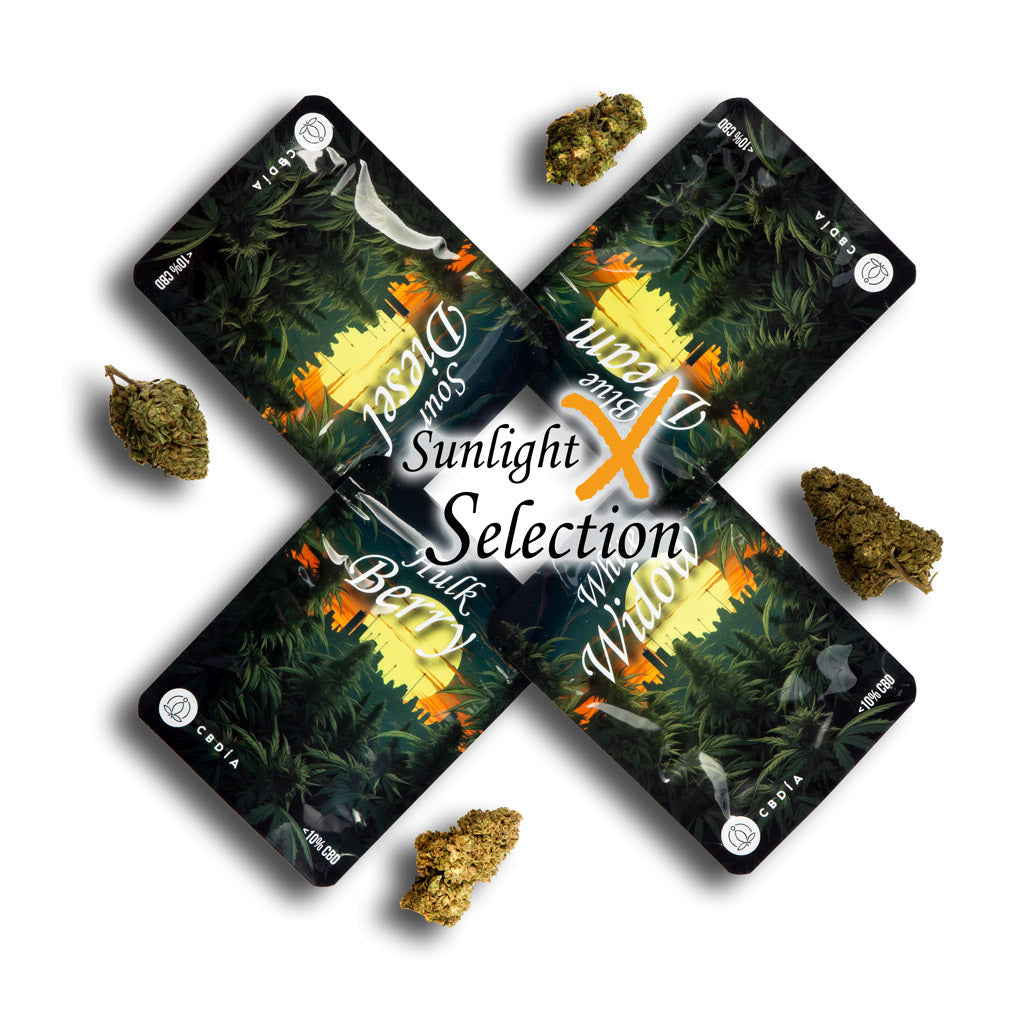


Cannabis without THC from EU industrial hemp
CBD flowers from EU industrial hemp with a maximum of 0.3 per cent THC, every batch with a lab certificate and origin with country and cultivation method.
Frequently asked questions about cannabis without THC

Jona Decker
Jona Decker is an author and editor specialising in CBD, cannabinoids and cannabis law. He studied business administration with a specialisation in empirical economic research and has been writing about cannabidiol since 2020. He has written for the magazine CBD360 since October 2020, where he now also co-heads the editorial team. For CBDÍA, he classifies products objectively, based on the lab certificate for each batch and documented origin.
The term “cannabis without THC” is usually meant colloquially: it refers to cannabis or hemp whose THC content is below a legally relevant limit, not necessarily a material with exactly 0.00% THC. “CBD without THC” is also often used this way, even though CBD and THC are different cannabinoids that must be assessed separately. You can find strains from certified industrial hemp in our CBD Flowers category.
This page sets out factually which limit currently applies to industrial hemp, what the difference is between CBD and THC, and why lab certificates matter for classification. It also covers terms such as flowers and the CBD flowers category, without making any product, consumption or effect claims. This information is aimed at adults aged 18 and over.
What does cannabis without THC mean?
Cannabis without THC usually does not mean completely THC-free plant material in practice. The term often refers to industrial hemp or CBD-dominant cannabis whose THC content is so low that it falls below the applicable limit. In Germany, this generally refers to the limit of 0.3 per cent THC. In the market, “without THC” therefore often means: within the legal framework, not necessarily absolute zero.
Phrases such as CBD without THC or hemp without THC should therefore also be read carefully. Genuine claims are ideally based on lab values, strain information and the specific product description. This matters because different hemp products can be processed differently, and residual amounts cannot always be technically ruled out entirely. Anyone looking for guidance can view CBD flowers as a category, but should pay attention to verifiable information on THC content and check whether the offer is classified as legal. What matters is not the marketing label, but the actual THC value of the respective product.
CBD and THC: the chemical difference
CBD and THC are two different cannabinoids from the hemp plant. Both terms are often mentioned together, but describe separate substances that are analysed individually in the lab and assessed differently under the law. It is therefore essential not to equate CBD content with THC content.
Classifying CBD as cannabidiol
CBD stands for cannabidiol. It is a component of the cannabis plant, or the hemp plant, and like other constituents belongs to the group of cannabinoids. When people talk about CBD without THC, this does not automatically mean a different plant species, but rather an analytical classification: the CBD content is determined separately, while the THC content is tested separately. Cannabidiol therefore describes a specific substance, not the overall composition of a product. This is why CBD can be stated in analyses without this already implying anything about other components. The guide What is CBD explains the origin and extraction of cannabidiol in more detail.
THC as a separate constituent
As the article what is THC shows, THC is also a cannabinoid, but chemically a different constituent to CBD. For the distinction, it is important that THC is separately measurable and is usually given particular consideration in legal assessments. The difference therefore lies not just in the name, but also in the analysis: a product can have a certain CBD content, while the THC content must independently remain below a set limit. Whether something is described as “THC-free” or “without THC” therefore depends on measured values, detection limits and the requirements that apply in each case.

Is cannabis without THC legal in Germany?
0.3 per cent THC: the current limit
For classifying cannabis without THC, the THC content is the key factor in Germany. Currently: industrial hemp may have a THC content of no more than 0.3 per cent. This does not necessarily mean that no THC is detectable at all, but that the content does not exceed this limit. Whether a product is legal, for example whether CBD flowers are legal, also depends on its specific composition and marketability. This also applies to CBD products, in which THC may only occur in small traces. This section does not replace a legal assessment of the individual case.
0.2 per cent: the old historical value
The frequently cited limit of 0.2 per cent THC is now only relevant in Germany as a historical value. It does not describe the current rule and should therefore not be used as a benchmark for present-day assessments. Anyone reading older articles, lab reports or product information should check which point in time they refer to. Currently, the limit of 0.3 per cent THC is the relevant one for general classification.
EU variety catalogue and industrial hemp
When it comes to hemp without THC, this is legally mostly about industrial hemp. What matters are approved varieties from the EU variety catalogue as well as formal requirements for cultivation, processing and placing on the market. The catalogue does not state that every flower or end product is automatically legal; it initially classifies the agricultural variety. In Germany, businesses and consumers must therefore distinguish between approved industrial hemp, actual THC content and the specific product form. A blanket claim of “legal” is not reliable without an individual case assessment.
CBD flowers, hemp without THC and strains
Terms such as CBD flowers, hemp without THC or CBD without THC are often used similarly in everyday language. Many products are also described by strain, CBD content or aroma. However, what matters is not the short label, but the verified measured value of the respective batch and the applicable limit.
Marijuana without THC and CBD weed without THC: the same thing, different words
Colloquially, marijuana without THC, weed without THC and CBD weed without THC mean the same as cannabis without THC: dried flowers from industrial hemp whose measured THC value is below the applicable limit. The difference lies in the terminology, not in the material, and for these terms too, the decisive factor remains solely the lab value of the respective batch.
Why “THC-free” does not mean absolute
When people talk about THC-free flowers, this usually does not mean in everyday market usage that absolutely no THC is detectable. This often refers to flowers whose value is very low and lies within the legally permitted range. CBD flowers can therefore also contain traces, which is relevant, for example, to the question of whether cats can get high, provided the lab analysis and limit classify this accordingly. Phrases such as hemp without THC are shortened and should always be understood with reference to analysis, batch and specific products.
CBD content, aroma and batch
For CBD flowers, factual information helps with orientation: the CBD content describes the measured proportion, aroma details classify the strain, and the batch number links the flowers to a specific analysis result. Terms such as premium quality do not replace this information. Anyone wishing to buy such products should check which batch is being sold and whether the values are documented; anyone who wants to form their own impression before their first purchase can request a free cannabis sample. CBD without THC therefore remains primarily a simplified term, not an automatic guarantee for every individual measured value.

Lab analysis: how THC content is tested
Lab certificate per batch
A lab certificate, often also called a COA, should always relate to a specific batch. This is the only way to trace which sample was tested and whether the information matches the product. Relevant details include the date, batch number, measured THC content, CBD content, as well as the name and details of the lab. Especially with claims such as THC-free flowers, the batch reference is important because natural raw materials can vary and not every harvest delivers identical values.
Analysis methods and detection limits
Labs quantify THC content using suitable analysis methods and also state detection or quantification limits. These limits help to classify values correctly: “not detectable” does not automatically mean that absolutely no amount is present, but that it may be below the stated limit. Anyone looking for CBD without THC should therefore read certificates carefully and pay attention to clear information. For assessing CBD products, all details together are important, including production, sample reference and how current the document is.
Conclusion: classifying cannabis without THC correctly
“Cannabis without THC” in practice usually does not mean completely THC-free cannabis, but CBD or industrial hemp products that fall below the limit of 0.3 per cent THC that applies in Germany. Anyone looking for CBD without THC should therefore pay particular attention to current lab certificates, batch references and clear classification in the CBD flowers category. So-called THC-free flowers should also continue to be carefully checked, so that the label, analysis values and product information all match up.
Note: This page is for general information purposes only and does not constitute legal or medical advice. The legal classification of products relating to cannabis without THC may change in Germany; the information is current as of August 2026. No claims are made regarding effects, use, dosage, treatment or illnesses. The content and products in this topic area are aimed exclusively at people aged 18 and over.