








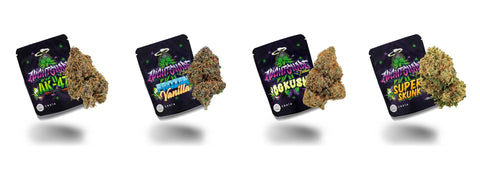
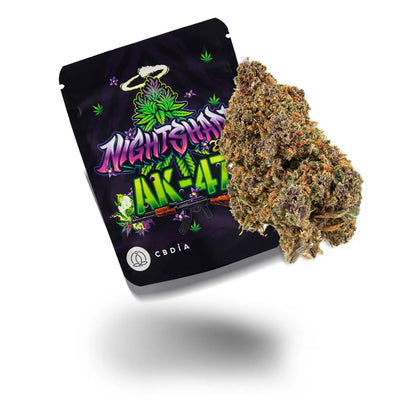
CBC is the abbreviation for cannabichromene, a cannabinoid that the hemp plant forms alongside CBD and THC. It is considered non-intoxicating, is researched considerably less often than the two well-known cannabinoids, and, like them, is initially present in the plant as an acid form. This guide explains what cannabichromene is chemically, how it forms, how it differs from CBD, THC and CBG, how it is classified legally, and how to recognise the CBC content of a flower. It deliberately makes no effect or usage promises.
What exactly is CBC: cannabichromene as a cannabinoid of the hemp plant
Cannabichromene belongs to the phytocannabinoids, i.e. the cannabinoids that form in the Cannabis sativa L. plant itself. Its structure was first described in 1966. A review on biosynthesis counts CBC, together with THC and CBD, among the most abundant cannabinoids of the plant by amount; in the specialist literature it is nevertheless usually listed among the so-called minor cannabinoids, because in most strains it lags considerably behind CBD or THC.
Through targeted breeding, there are now strains in which CBC accounts for a larger share of the cannabinoid profile. At CBDÍA, these are the CBC flowers: flowers from EU hemp whose THC content is below 0.3 percent and whose values are stated in the laboratory certificate per batch.
Important for a basic understanding: the abbreviation CBC is ambiguous. In English-language medicine it also stands for "complete blood count". This meaning has nothing to do with the cannabinoid cannabichromene.
How cannabichromene forms in the plant: from CBGA via CBCA
In the growing plant, cannabigerolic acid (CBGA) comes first. It is the shared precursor of the well-known cannabinoids; how cannabigerol itself is classified is explained in the article What is CBG. The plant's own enzymes, so-called synthases, convert CBGA into different acid forms: THCA synthase into THCA, CBDA synthase into CBDA, and CBCA synthase into cannabichromenic acid (CBCA).
In fresh plant material, THC, CBD and CBC are present predominantly in these acidic forms. Only heat, light or storage split off carbon dioxide, a process called decarboxylation, turning CBCA into CBC. This is why the values differ depending on strain, ripeness, drying, storage and the time of analysis.
Why the strain determines the CBC share
Which acid form predominates depends on the genetics, i.e. on which synthases a strain forms and to what extent. According to the current state of research, the biosynthesis of the rarer cannabinoids is not yet fully understood; what is established is the pathway via CBGA and CBCA.

Chemical structure: why CBC is not a dibenzopyran
Cannabichromene has the molecular formula C21H30O2, the same as THC and CBD. However, the atoms are connected differently. In the PubChem database, CBC is listed as a chromene compound: an aromatic ring joined to an oxygen-containing ring, plus an open side chain. THC, by contrast, has three interconnected rings, the so-called dibenzopyran skeleton. This structural difference is not only chemically interesting but also decisive for the legal classification below.
CBC compared to CBD, THC and CBG
CBD, THC, CBG and CBC all come from the same plant and the same precursor, but are distinct substances with their own structure. Briefly classified:
- CBD is usually the most abundant cannabinoid by amount in hemp and the best studied; the basics are in the article What is CBD.
- THC is the intoxicating cannabinoid; in CBDÍA's flowers it is below 0.3 percent; more on this in the article What is THC.
- CBG, as cannabigerol, is the neutral form of the shared precursor CBGA and usually occurs only in small amounts.
- CBC forms via its own acid form CBCA, is considered non-intoxicating, and is the least researched of the four.
What research describes about the properties of cannabichromene and how thin the data situation is in humans is put into context in the article CBC effects.

Legal classification of cannabichromene in Germany
Legally, cannabichromene is classified in Germany as follows: CBC is not listed in any of Schedules I to III of the German Narcotics Act (BtMG). It is also not covered by the German New Psychoactive Substances Act (NpSG), because the substance group in Schedule 1 No. 2.3 covers compounds derived from the dibenzopyran skeleton (6H-benzo(c)chromen-1-ol), and CBC is a bicyclic chromene without this third ring.
As a plant constituent of hemp, CBC falls under the hemp exemption pursuant to Section 1 No. 8 (d) and No. 9 of the German Consumer Cannabis Act (KCanG), namely under the hemp conditions: the plants come from certified seed of varieties in the common EU variety catalogue, or their THC content is at most 0.3 percent, and distribution serves exclusively commercial or scientific purposes that rule out abuse for intoxicating purposes. Products are supplied only to adults aged 18 and over. Not legal advice, as of: September 2026.
Recognising cannabichromene in the laboratory certificate
How much CBC a flower contains cannot be read from its appearance, scent or strain name, only from a laboratory analysis. A laboratory certificate states the individual cannabinoids separately, often as the neutral form and as the acid form, i.e. CBC and CBCA. Alongside this is the THC value, which is below 0.3 percent in CBDÍA's flowers.
When reading it, a brief check helps: do the product name and batch number match the product, is the test date stated, and are CBC, CBD and THC listed individually? At CBDÍA, the laboratory certificates per batch are publicly available, together with the country of origin and cultivation type of the respective strain.
This article is for general information purposes only and does not replace medical advice or legal advice. As of: September 2026.


