









The OG Kush strain is one of the most famous cannabis lines of all: where does OG Kush come from, what genetics is it attributed to, and why is the strain so often linked to the Kush family? In this strain profile, we classify OG Kush objectively and look at its origin in California, its attributed crosses and its typical aroma characteristics.
OG Kush Strain: Origin in California
The OG Kush strain is considered a classic, internationally known strain whose origin is only patchily documented. OG Kush is usually associated with California in the early 1990s; which strain actually served as the original remains disputed. It's exactly this mix of fame and unclear history that explains why the strain is still so often discussed today.
At CBDÍA, the strain is available as the OG Kush CBC flower from the Nightshade Edition: hemp from EU-certified seed, grown in a glasshouse in Austria, with THC below 0.3 percent.
What Does the Name Mean?
The name OG Kush is explained in different ways. You often come across interpretations like “Original Gangster” or “Ocean Grown”; both belong to early US cannabis culture but are not clearly documented. Today, OG mainly stands for a certain style, while Kush refers to the wider Kush family.
Genetics and the Kush Family
Various accounts circulate about the genetics of OG Kush. Chemdawg and Hindu Kush are often named as reference lines, sometimes supplemented with further US genetics. These are not conclusively proven family trees but attributions from the strain scene. OG Kush is usually described as a hybrid with Indica-leaning traits; why such labels only offer rough orientation is explained in our article on the difference between Sativa and Indica.
Kush as a Family of Modern Strains
Today, Kush stands for a whole family of strains. The name refers to the Hindu Kush mountain range between Afghanistan and Pakistan, a region from which many compactly growing landraces originate. Kush strains commonly share earthy, spicy and resinous scent patterns as well as compact growth. Many modern crosses use OG Kush as a starting point, which is why Kush appears in numerous strain names. Even so, not every Kush strain is the same, because selection and phenotype play a major role.

Aroma and Terpene Profile
The OG Kush strain is often described via a striking aroma: earthy, resinous, spicy and citrusy. The scent picture often recalls forest floor, resin and spices, with a distinct pine note added. In the background, citrus hints appear, sometimes also a fuel-like note that OG Kush shares with the Chemdawg line. Not every sample smells identical.
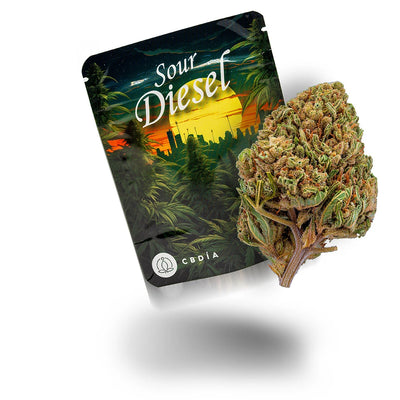
Terpenes are aromatic plant compounds that shape smell and taste. Myrcene is often associated with earthy, herbal notes, limonene with citrus freshness, caryophyllene with peppery spice. Depending on cultivation, ripeness and processing, the proportions shift, so OG Kush is perceived as sometimes darker, sometimes fresher. A similarly diesel-like but Sativa-leaning profile is described in our profile on Sour Diesel.
OG Kush Effects: What Is Reported About Them
On the effects of OG Kush, mainly strain descriptions and user reports are available; robust studies on individual strains are lacking. In these, the classic, THC-containing strain is often described as rather relaxing. How such accounts turn out depends on THC content, the batch and the individual.
The OG Kush flower at CBDÍA is a CBC flower made from hemp with below 0.3 percent THC and is not classified as intoxicating. CBDÍA makes no statements about effects here; what matters is the strain profile, terpenes and the batch's lab certificate.

The Plant: Growth and Flowering Time
Typical for OG Kush is compact to medium-sized growth with strong branching and relatively closely spaced side shoots. The plants develop firm, resinous buds with a rather squat structure. Flowering time is usually given as around eight to nine weeks in strain descriptions. OG types are also considered sensitive to environmental conditions but remain easily recognisable in appearance.
At CBDÍA: as a CBC Flower
Whether a strain is legally marketable in Germany doesn't depend on the name, but on origin and THC content. The classic OG Kush genetics is not a CBD product. The OG Kush flower at CBDÍA, by contrast, belongs to the Nightshade Edition with a focus on the cannabinoid CBC, comes from hemp grown from EU-certified seed, contains below 0.3 percent THC, and is sold only to adults aged 18 and over. The second strain of this edition is described in the profile on the AK-47 strain.
Conclusion: The Strain at a Glance
The OG Kush strain stands for a Californian Kush strain whose exact origin has not been fully clarified but which has shaped many modern strains. It is attributed Chemdawg and Hindu Kush lines, and in aroma it combines earthy, resinous and citrusy notes with a typical pine note.
Note: This profile describes the strain botanically and aromatically. It contains no statements about effects, consumption or dosage and does not replace legal advice. Sale only to adults aged 18 and over. As of: September 2026.