




The first days after germination often decide whether cannabis seedlings establish themselves stably or show stress early on. In this phase, the young plants are sensitive: roots are only just developing, and leaves react quickly to too much water, incorrect light or unsuitable nutrients. That is why it is worth observing cannabis seedlings closely, rather than intervening prematurely. How the fully grown plant is later structured is explained in the guide on the cannabis plant.
This guide helps you classify typical care questions: how do you recognise healthy growth, when are yellowish leaves a warning sign, and what can an oversupply be due to? The focus is on recognising, preventing and objectively assessing common mistakes. This gives you a better feel for what seedlings need in the starting phase and which changes in cannabis deserve early attention.
Caring for cannabis seedlings: the first two weeks
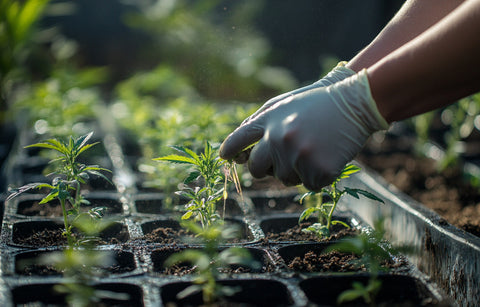
Cannabis seedlings are young plants in the early stage of development after germination. A small root first emerges from the seed; at this point, the term usually used is cannabis germling. As soon as the germling reaches the surface, opens its first cotyledons and starts to absorb light independently, it counts as a seedling.
Vigorous seedlings start with good seeds from the EU variety catalogue and correctly germinating cannabis seeds.
The difference from other terms is important: seeds are still dormant starting forms, germlings are directly in the transition to the first visible plant, and seedlings already have first leaves and young roots. Starter plants are somewhat more developed young plants that usually already grow more stably. Cuttings, on the other hand, do not come from seeds but are cut from an existing cannabis plant and rooted; cuttings are therefore genetic copies of the mother plant.
In this phase, the plant is particularly sensitive, because roots, leaves and metabolism are not yet fully resilient. Too much or too little water, unsuitable soil, strong light or early nutrient applications can quickly stress seedlings. A calm, adapted environment helps them move stably into the next growth stage.
How long does the seedling stage last?
From germination to the first leaves
How long the seedling stage lasts depends on genetics, environment and general vigour. Typically it is a few days to a few weeks. First the seed opens, then a fine root appears. From this early base, cannabis germlings develop, which shortly afterwards show their first cotyledons. These leaves are not yet a sign of vigorous growth, but the starting point. During this time, the roots also continue to develop, while above ground, changes are often only slowly visible.
How to recognise healthy seedlings
Healthy cannabis seedlings look upright, have a fresh green colour and show even, calm growth. The small plants should not hang limp for long periods or stretch excessively due to lack of light. What you should pay attention to above all is stability: as soon as the stem appears a bit firmer and new leaves keep coming, the plant becomes more resilient. Important roots also develop below the surface during this time, which later carry the supply. Good development does not mean that big leaps are visible every day. Seedlings often simply need time. If the plants remain stable over several days, continue growing and show no noticeable discolouration, this speaks for healthy development in the first weeks.

The right environment for cannabis germlings
Young plants develop most stably when conditions remain even. What matters is a suitable temperature, moderate humidity, loose soil and carefully dosed water. The right environment reduces stress and helps you recognise changes in your plant early. Ideal is a calm, clean propagation environment with sufficient moisture, but without wet, compacted soil.
Light for seedlings: bright, but not too harsh
Cannabis seedlings need bright, even light so they grow compactly and stably. If the light is too weak, seedlings often stretch strongly upwards and form thin, unstable stems. Light that is too intense, on the other hand, can cause stress, especially if leaves appear very pale or the surface dries out quickly. You do not need to follow complicated plans with fixed hours; instead, you should observe the plants and position them appropriately. A calm location with gentle, reliable brightness supports even growth better than abrupt changes.
Watering seedlings: keeping the soil lightly moist
Many mistakes happen with watering in the first phase. The soil should stay lightly moist, but not permanently wet. Too much water displaces air in the substrate, which makes the roots work less well; too little water quickly makes young plants look limp. Therefore, check regularly whether the soil dries out on the surface while still holding a little moisture inside. A small container helps you control watering better. Some symptoms are prematurely interpreted as cannabis overfertilisation, even though uneven moisture or waterlogging is the cause.
Which soil suits the first phase?
For cannabis seedlings, soil that stays loose, absorbs water evenly and is not too heavily pre-fertilised is suitable. At the start, young plants do not need large amounts of nutrients, but above all a stable environment for root formation. A good structure ensures the roots get oxygen and can spread without resistance. Very heavy or highly nutrient-rich soil can unnecessarily burden the conditions; more on this in the article on which soil suits cannabis. Therefore look for a fine, airy substrate that holds moisture without becoming waterlogged.
Recognising cannabis deficiencies
Correctly assessing yellow leaves in cannabis
Yellow leaves in cannabis are a common warning sign, but not automatically a clear deficiency. Individual older leaves can naturally change colour, while many yellow patches on young shoots rather indicate stress. Possible causes are too much water, an unbalanced nutrient ratio, an unsuitable pH value, light stress or compacted soil. You should therefore never base cannabis deficiencies on a single leaf. Always check whether other symptoms are also present, such as drooping leaves, spots or slowed growth. Hasty corrections can burden the plant further.
Observing roots, growth and colour
To better assess cannabis deficiencies, observe several characteristics at once. The colour of the new shoots, stability, growth and the condition of the soil together give a clearer picture than a single symptom. Healthy roots need oxygen and an evenly moist, but not wet, environment. If growth stalls, this does not necessarily mean a lack of nutrients; too much water or an unfavourable pH range can also disrupt uptake. Observe the plants for a few days before intervening.
When it is better not to fertilise immediately
Seedlings in particular often do not yet need additional nutrients, because propagation soil or lightly pre-fertilised soil already provides enough supply. If you apply cannabis fertiliser straight away when leaves turn yellowish, this can cause cannabis overfertilisation or worsen an existing problem. If you are unsure, first check moisture, distance to the light and temperature. Only once the plant appears stable and shows clear deficiency signs over several days does careful additional feeding make sense.

Avoiding cannabis overfertilisation
Cannabis overfertilisation often arises from good intentions: young plants are meant to get off to a strong start, but receive too many nutrients too early. Seedlings in particular need, above all, stable moisture, mild soil and calm conditions in the first days. Too much fertiliser burdens the fine roots and can trigger symptoms that are easily confused with cannabis deficiencies.
Most common signs of overfertilisation
The most common indications include very dark leaves, leaf tips curled downwards, and small brown or yellowish burns at the edges. Growth often appears stressed, even though the plant seemingly gets enough water and light. Cannabis overfertilisation cannot always be recognised immediately, because similar symptoms can also result from soil that is too wet, poor drainage or light that is too intense. That is why you should not immediately keep fertilising, but first check whether watering, distance to the lamp and temperature are right.
Why less fertiliser is often the better approach
For seedlings, restraint is usually the safer approach. They do not need all additives at once, but time to build a stable root system. If you want to start fertilising, do so only gradually and at a noticeably lower dose than is usual for larger plants. Observe the reaction over several days rather than immediately adding more. Suitable conditions, even moisture and soil that is not too heavily pre-fertilised often help more than additional nutrients. This reduces the risk of cannabis overfertilisation, and the young plant can develop evenly.
When should seedlings be repotted?
Signs that more space is needed in the container
Cannabis seedlings should only be repotted once they appear stable enough and the current container is visibly reaching its limits. Indicators are even leaf development, upright growth and first signs that the roots are making good use of the available space. As soon as growth slows despite suitable conditions, limited space may play a role. In this phase, it is less about haste than about observation: seedlings that continue developing calmly do not need to be moved or repositioned unnecessarily early.
Keeping stress low during repotting
When cannabis seedlings are repotted, gentle handling matters most. Small plants react sensitively to frequent movement, pressure on the root area and abrupt changes in the environment. The root ball should be disturbed as little as possible, so the plant is not additionally burdened. After repotting, it makes sense to observe your plants closely, but without hasty intervention: if leaves droop slightly for a short time, this is not always a problem. However, if development clearly stalls or discolouration appears, care should be reviewed before the plants are burdened further.
From seedlings to CBDÍA shop categories
Anyone who observes cannabis seedlings quickly learns how closely genetics, origin and cultivation are related. This understanding also helps you assess categories in the CBDÍA shop objectively: whether it is about hemp, a specific variety or hemp seeds, what counts is not just names, but verifiable information.
If you want to buy hemp seeds or compare cannabis seeds, look for clear information on seed type (feminised, autoflowering or regular), variety and genetics, flowering time and germination capacity, as well as fresh storage. This helps you better recognise which variety suits your information needs and which details speak for quality.
For growers, the best decisions are usually the ones based on data rather than promises. This applies to cultivation just as much as to assessing cannabis products. In the CBDÍA context, only adults aged 18 and over may buy such products.
Conclusion: healthy germlings need calm
Healthy cannabis seedlings arise mainly from constant, calm conditions that pay off right up to harvesting cannabis. Seedlings react sensitively to too much water, strong soil, abrupt temperature changes and early fertiliser applications. If you water carefully, use a loose, mild soil and keep light and moisture stable, you support even growth without unnecessarily stressing the young plants.
Observe your plants daily, but do not intervene immediately at every small change. Slightly yellowish leaves, dark tips or stalled growth can have various causes. Cannabis deficiencies often show up differently from cannabis overfertilisation, yet some symptoms overlap. What matters, therefore, is always checking the whole context: substrate, watering behaviour, nutrients, light and development of the plants.
In this phase, correct care mainly means restraint. If you choose suitable propagation soil, small pots and simple aids, you create a solid basis for healthy seedlings and the next step in rearing up to the cannabis flowering stage.
Legal notice for adults
This article serves solely for general information about cannabis and private cannabis cultivation. Please always observe all applicable laws in your location before you want to buy or grow products. CBDÍA is aimed only at adults aged 18 and over; CBDÍA products contain a maximum of 0.3% THC.
Legal notice: under Section 9 of the German Consumer Cannabis Act (KCanG), adults aged 18 and over may grow at most three cannabis plants at a time at their place of residence or habitual abode in Germany. This article describes gardening basics and is not a substitute for legal advice. No statements on effects, consumption or dosage. As of: September 2026.