




If you are wondering which soil is suitable for cannabis, it is not just about pre-fertilised or unfertilised soil. Structure, water retention, aeration and the right pot size for cannabis depending on the stage of development are also decisive. Good cannabis soil gives the roots support, stays loose enough for oxygen, and supports stable plants without overloading them early on. The right soil therefore depends on whether you are supplying seedlings, young plants or flowering hemp plants. The substrate and possible additives such as perlite, compost or coco fibre also influence how well water and nutrients remain available. This guide gives you an objective orientation on important soil properties, sensible categories and suitable pot sizes, so you can better assess the question of the right foundation for your growing.
Which soil for cannabis: suitable substrates
In short: a loose, lightly pre-fertilised or moderately nutrient-rich soil for cannabis is suitable, one that holds water well but reliably drains excess moisture. Good drainage, an airy structure and a stable pH value are more important than a particularly heavily fertilised substrate. This way the roots get oxygen, while the plant is supplied with nutrients evenly.
You can find varieties for soil and pot among our cannabis seeds, and matched nutrients under cannabis fertiliser.
There is no single best soil. Which soil suits you depends on the stage of the plant, the pot size, and how intensively you want to feed and control things later on. For young plants, a milder soil is usually sensible, while larger plants in a bigger pot may cope better with somewhat more nutrient-rich soil for hemp plants.
When choosing a cannabis soil, pay less attention to marketing claims and more to the composition: it should remain crumbly, not compact, and distribute moisture evenly. The best choice is the one that suits your growing style and offers an optimal balance of air, water and supply.
What properties does cannabis soil need?
Good soil for hemp plants is not just a carrier material; it determines how well cannabis plants can absorb water, oxygen and nutrients. How the roots, stem and leaves of a hemp plant are connected is shown in the overview of plant structure. What matters is the interplay of loose soil, a balanced nutrient base and a suitable pH value. Only when these factors work together can healthy roots develop stably.
pH value, water and drainage
The pH value is an important reference point because it influences how available individual nutrients are in the substrate. For cannabis soil, the sensible range is usually slightly acidic to neutral. Equally important is how the soil holds and releases water. It should store moisture without compacting. Functioning drainage ensures that excess water can drain away and waterlogging does not occur. This keeps enough oxygen in the root zone, reducing stress and growth problems.
Nutrients and an airy structure
A suitable hemp soil supplies nutrients in a balanced form: not too heavily pre-fertilised, so that young plants are not overwhelmed, but also not so poor that deficiency sets in early. An airy structure encourages the roots to branch and grow actively. At the same time, the substrate must remain stable enough that it does not collapse when watered. Good cannabis soil therefore combines nutrient supply, air pores and water-holding capacity into a resilient balance.

Grow soil, hemp soil or universal soil?
Whether grow soil, hemp soil, cannabis soil or normal potting soil: the difference lies less in the name and more in structure, pre-fertilisation and composition. Specialist products are often tuned for strong root growth, good drainage and a suitable nutrient base. This can bring advantages, especially if you are looking for a substrate that is suitable without many adjustments. Universal soil can work, but is often denser, more heavily or unevenly fertilised. There is therefore no single best soil across the board; what matters is which soil for cannabis suits the plant, the stage and your setup.
What distinguishes high-quality soil?
You can recognise high-quality cannabis soil by an even grain size, a loose but stable mix and clearly declared components. It stores water without remaining permanently wet, while still letting enough air reach the roots. A moderate level of pre-fertilisation is also important: too many nutrients can burden sensitive plants, too few quickly lead to deficiency. Good cannabis soil therefore offers balanced properties rather than extreme values and remains structurally stable over several weeks.
Which soil for young plants?
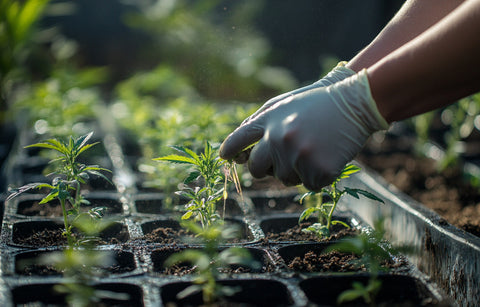
For young plants, the soil for hemp plants should be rather mild, loose and not overloaded. Especially the first stage after germinating cannabis seeds benefits from a substrate that is easy to root through and provides nutrients only sparingly. A heavily pre-fertilised specialist soil is not always the best choice. If you use universal soil for this purpose, it should be fine, airy and as evenly composed as possible.
Which additives improve the soil?
Additives can specifically improve a cannabis soil if they suit the structure and water balance. On soil bags you will often find terms such as perlite, vermiculite, coco fibre, worm castings or compost. What matters is not the longest list, but a balanced substrate: the soil for hemp plants should remain loose, store water sensibly and drain excess moisture.
Using perlite and vermiculite
Perlite is a mineral component that provides an airy structure. In a mix, perlite creates small air pores, reduces compaction and supports drainage, so roots do not sit permanently wet. Vermiculite works differently: it can hold water better and releases moisture gradually. When assessing such additives, a functional view helps: perlite mainly improves aeration and drainage, vermiculite is more about water management in the substrate.
Coco fibre, worm castings and compost
Coco fibre improves the structure, loosens the soil and can help keep a mix more evenly moist. Worm castings and compost are organic components that add nutrients and soil life; worm castings have a particularly fine structure. However, for good hemp soil, what counts is not combining as many additives as possible. What matters is quality, degree of maturity and composition. An organic soil with clearly declared components is easier to assess than an overloaded mix with no traceable function.

Which pot size suits which stage?
Besides the question of which soil makes sense for cannabis, pot size also determines how stably the water balance, root development and growth fit together. Small containers give you more control at the start, larger ones offer more buffer later on. The optimal choice depends not only on the stage, but also on space, standing time, care effort and your growing situation.
Small pots for the first stages
In the early stages, smaller pots are often easier to manage, because you can better assess the water requirement. Less unused substrate means water does not sit in the pot for as long, and the roots make contact with the surrounding soil more quickly. Young cannabis plants in particular react sensitively to permanently wet areas. A moderate pot size for cannabis makes care easier and supports even growth, without you already having to keep a lot of soil in reserve.
Larger pots for more root space
Larger pots become interesting when cannabis plants stand for longer or need more root space. More soil can store water and nutrients from cannabis fertiliser better, but also results in more weight and a greater space requirement. Pot size for cannabis should therefore suit the planned standing time, for example when plants remain in the same stage for several weeks. Also important is suitable soil for hemp plants: a loose, structurally stable soil for strong roots helps avoid waterlogging and supports further growth.
Common mistakes with soil and pot size
A common mistake is soil for cannabis that is too dense: if the structure lets hardly any air reach the roots, water stays in the substrate longer, and waterlogging can result. Poor drainage is also often noticeable in soil that looks wet for a long time or smells unpleasant. Good soil for hemp plants is therefore not only nutrient-rich, but also remains loose and permeable at the same time.
An unbalanced nutrient base is also problematic. Soil that is too heavily pre-fertilised can burden young plants such as cannabis seedlings, while very lean mixes make additional fertiliser necessary early on. More fertiliser is not automatically better here, because salt levels can rise. For pot size in cannabis, what matters is a suitable ratio between root space and plant stage: containers that are too small limit growth, while those that are too large often keep the substrate wet for longer than necessary. Anyone growing in the garden instead of a pot will find information on soil and location in the guide on the outdoor cannabis plant. Warning signs are slowed growth, drooping leaves or a permanently wet surface.
Correctly assessing quality in the CBDÍA shop
Just as you pay attention to verifiable properties with hemp soil or cannabis soil, it is also worth looking at demonstrable quality features with CBD products. Important are a lab certificate per batch, a clear origin with country and growing method, and reference to hemp from the EU variety catalogue. In addition, a transparent cannabinoid and terpene profile helps you better assess the composition.
The CBDÍA shop thus offers orientation, without you having to rely on blanket claims. Nonetheless, check all products individually and pay attention to which quality information is actually documented. A professional classification can additionally be found via the author profile of Jona Decker.
Conclusion: choosing suitable soil and pot size
If you are wondering which soil makes sense for cannabis, pay attention above all to a loose, structurally stable soil with a balanced nutrient supply. The best choice always depends on the stage: propagation needs a mild substrate, while later on, right up to the flowering stage of cannabis, the cannabis soil may be more nutrient-rich. Equally important is the right pot size for cannabis, so your plants can develop roots without standing too long in too much wet medium. You will find the optimal combination of the right pots, suitable soil and complementary products best if you plan substrate and pot size together, with an eye on the later harvesting of cannabis.
Note: CBDÍA products are sold exclusively to adults aged 18 and over. The statutory THC limit of 0.3 per cent is always observed.
Legal notice on the topic of growing cannabis yourself: under Section 9 of the German Consumer Cannabis Act (KCanG), adults aged 18 and over may grow at most three cannabis plants at a time at their place of residence or habitual abode in Germany. This article describes gardening basics and is not a substitute for legal advice. No statements on effects, consumption or dosage. As of: September 2026.